Friday, February 16, 2007

Less of Pakistan, more of China


This is might be pretty obvious but let me just say it out for the record: "India and Pakistan" seems to be occurring less and less in news and "India and China" is on a slow rise (notice the little spike somewhere mid-2006). But hey it takes a little bomb blast or a gun fire in the border to get the "india and pakistan" spike up, so just keep your fingers crossed hoping nothing abnormal happens.

Wednesday, February 07, 2007

Enough Coverage?

Steve Herrmann of BBC talks about BBC and its place in Rising India. He also asks how they differ from/compare to the local media channels in India.

Here at UC Berkeley, there is a little tradition of having the main pages of selected daily newspapers on a library wall. There are six slots, two of which are taken: The Washington Post, The Guardian. Two of the other four slots are most often (9/10 times) taken by the Jerusalem Post and the Arab News. The final two slots are more generic, usually taken by South China Morning Post, The Asahi Shimbun, The New Anatolian, Irish Independent and rarely (i mean rarely) there is The Times of India. So everyday when I look at that wall, I tell myself “Well, Middle East is definitely important. But is it worth 9/10 times when the two giant countries China and India are rising ??”. I get a similar feeling when I watch BBC in India. BBC is of course outstanding in its coverage, analysis etc. etc…but does it cover enough of India when it does Indian programming? Most of the times, it is far less when compared to NDTV and its ilk.

Sunday, January 21, 2007

Life, Liberty and the Pursuit of Happiness

If there should be a change to this famous phrase about the inalienable rights of citizens asserted by Thomas Jefferson in the declaration of Independence, it should probably be the spelling of happiness to happyness (note the y).

The movie inspired by real life rags-to-riches story of Chris Gardner, a self-made millionaire, set in the early 80s. One of the first scenes of the movie shows Reagan talking about years of economic downturn on one of those old TVs with a knob. Chris struggles to sell a portable version of a hard bone density scanner (or whatever) which btw looks like a 80s portable computer given that the movie is set in San Francisco. Anywho, he has a really really hard time paying the bills and house his kid.

Chris has a thing for neatly dividing his existence into phases like "being stupid", "running across SF" (to catch up with 101 things trying to pull apart his already below the poverty line existence)* etc. As the movie detailedly fleshes out the abject poverty of a black man, it can get very depressing and even tear-jerking. But on the upside, smiles, smarts and most of all the fatherly love and the warmth between him and his son keep you hoping for that concluding phase of brief period of happyness.

The movie avoids saccharine sentiment but at the same time takes two full hours to sketch out Chris Gardner's exhaustive runs up and down the hills of both San Francisco and his own life.

The movie for the most part concentrates on details of pursuit of riches (or in this case, riches for bare-minimum existence), but the movie has its greatest justification for the title, when in the end Chris realizes part of his what-i-can-be-dreams and starts walking away from constant disappointments with himself.

* Being poor has a huge price. A study about price comparisons in Dharvi (the biggest slum of Bombay and Asia) and a close-by well to-do neighborhood has concluded that clean water is about 30 times costlier in Dharvi.

Thursday, December 14, 2006

Keshava guy again

I am 'Keshava' guy in this latest episode of a popular desi podcast called "Desi Dilemmas". The producer of the podcast reads out one of my earlier post on Hindu temples in United States. Tell me what you think

Monday, December 04, 2006

Amazon's unspun

Amazon has a new service called unspun that crowd sources compilation of various best lists. The idea is get people vote and sort the different categories by votes. Its ajaxified, built using ruby on rails and asks for a login before it lets you vote. I tried to find out if the number of votes has any correlation with the size of its wikipedia article (if thats any measure of popularity).


Unspun Vs. Wiki Graph


(Update: Replaced the table with the graph and moved the table to 'more')

Clearly, the wikipedia-size curve has spikes like Word, Openoffice, Corel and valleys like notepad and Ultraedit. On the other hand, if the table is sorted by wikipedia-size, textmate is a prominent spike on the vote curve. Well, its the same crowd, does it make sense for these to smoothen out? May be, yes.


There's probably some alpha-beta user bias in the voting at this point as seen in this favorite subject list or Patrick Stewart (above Marlon Brando) in this list. But that should even out as this service becomes popular. While its easy to normalize and give them a letter grade, I wonder how a letter grade approach would work as opposed to ranking them. I find it hard to rank Marlon Brando, Robert De Niro, Al Pacino, Jack Nicholson, Tom Hanks, Kevin Spacey, Dustin Hoffman in a particular order. Now bring in non-Hollywood actors like Sivaji Ganesan, Amitabh Bachchan, Kamal Hassan or Toshiro Mifune. It only gets harder. I find it lot easier for me to give them a letter grade. Grading may be less mentally taxing than ranking and hence increase participation. On the other hand, grading doesn't pump up enough adrenalin for most users. Its probably not enough incentive to campaign for a better rank of their favorite item. Anyways, keep exploring and comment some of the interesting lists you stumble upon.

Tuesday, November 28, 2006

Zune and Network effects

Zune owners have a familiar story, there are not enough zunes around to use Wi-Fi to share music.

What would be really interesting is if Apple adds Wi-Fi to iPod and both Apple and Microsoft allow to share music across networks which can lead to some awesome discoveries (but at the same time it would be one long horrendous nightmare for the music industry). On the other hand, what would be terrible is if apple adds Wi-Fi and iPod and Zune dont talk to each other !! That would be like owning a phone but cannot make calls to 70% of the world (or <1%>

Tuesday, November 14, 2006

Can temples be more retrograde?

One thing that kept me bothering from the moment I first visited a temple here in the US is....temple architecture. Temples here remain more or less archaic with one exception: the fire-alarms and sprinklers on top. They are an excellent illustration of "post-industrial vedic society with retrograde-est things possible" phenomenon. Like in any culture, for a long time, temples were places of public gathering in India, not any more though. Apart from the usual architectural differences between temples of North and South India, one significant difference is ventilation. Tropics made temples of South India more ventilated, while colder weathers up north made them less naturally ventilated.

Temples here have a similar story. Climate and Air-conditioning make them close walled. Temples are THE places of gathering for Desis, grocery stores being a close-second. Some guy said he is looking for a job and put up his resume on a temple notice board in San Jose! From 'Camry for sale' to furniture to music classes to India tickets to SP Balasubramanyam's benefit show to a local desi DJ party .....everything ends up on a temple notice board. Temples have been embracing enough in these instances.

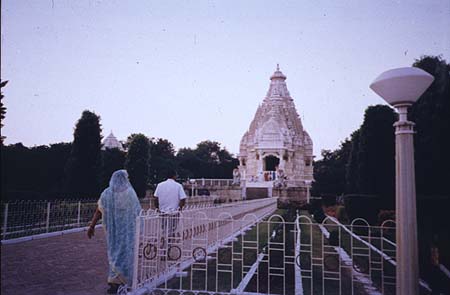
But why do they have to look exactly like the ones built by Raja Raja Chola or Krishna Deva Raya?? Why do they have to the same ornamentation on walls and the roof invented centuries ago? The only innovation I can appreciate is...coloring the ornamentation... as done on the outer gopurams of the Meenakshi temple in Madurai even though it may sound a little cheesy and non-traditional (non-vaidika) for many brahmins. Oh, wait! How can I forget this great innovation? The Saraswathi temple in Pilani (home to BITS Pilani) is modelled after one of those exotic Khajuraho temples. But the high point is when you notice the busts of Lincoln, Ramanujan, Vivekananda, Paramahamsa, Pasteur, Einstein, Tagore and other 'kids of Saraswathi' on its white marble walls. Thats some re-interpretation of Saraswathi, I thought. GD Birla was truly a visionary. (Well, I've to admit that I went to school there. But even with out those allegiances, I' would admit that Saraswathi Mandir is quite something).

Now, here is a country that is the home to some of the greatest modern architects on the planet: Lloyd Wright, Frank Gehry, Louis Kahn and Maya Linn ( I choose these people in this context... as these are the guys who have an outstanding sense of blending with nature, flowing shapes, natural ventilation and a sense of time). The 'model minority' of the nation with all its wealth, advanced degrees and progressiveness goes to temples frozen in 15th century! The low point was the Swaminarayan temple in Chicago. Tonnes of money were spent on the temple, tonnes of marble was mined from God knows where. There is an elaborate tour of 'Sanatana Dharma' along the entrance. But I felt extremely claustrophobic when I stepped into the actual temple. Its like a dungeon with little sun light coming in. They only got more money to spend on 'disco lighting'. I couldnt avoid drawing comparisons to the cave paintings of France. The only difference, the visitors here are not high on narcotics.

The other extreme was a small time temple in Artesia, near Los Angeles. A church in a neighborhood which recently became 'Little India' ...was converted to a temple. The temple didnt have any inner sanctum and a formal priest. It didnt have a shoe stand, it had a coat closet and rows of seating. But was I comfortable with the whole thing? Not completely. I didn't find it original enough. It was too practical ( :D ). It was too much of change. It was not building on any of the existing 'culture' nurtured and matured through centuries of time.

But I believe there is a middle ground. I believe there has to be an evolution. An evolution from those 15th century architectural approaches to something more modern but at the same time retaining the core philosophy of the traditional approach. Chola's Brihadeeswaralaaya is state-of-the-art because, at that time it was higher than anything around it. It took some innovative engineering techniques to build temples using massive amounts of rock. It held people in awe. I am not sure if taking a 15th century approach to constructing a temple today has the same effect.

The mere fact that these temples are in the United States, somehow raises my expectations a lot. In this country, there can be a Vegas kind of extravagance, a bible belt kind of conservatism but there will be and should be a religious equivalent of Maya Lin's contemplative Vietnam War Memorial.

Thursday, October 12, 2006

Google toll-free?

Not sure if this is done by Google, but call 1-877-GOOG-411 to check out Google Local Search thru phone. The interface sucks a little bit though. It doesnt care for your voice until it finishes spitting out all the ten results.

Sunday, October 08, 2006

Indian signboards


IMG_0609
Originally uploaded by Balaji Tanguturi.
Directions to four places in two languages. That requires effective usage of space. :-)

Wednesday, October 04, 2006

The Right Question

As US crosses the 300 million mark, lots of newspapers ask the question: Can US handle the growing population? May be the right question should be "Can the world handle a growing a population of intense resource guzzlers?". Just to remind myself, I am part of the increasing population.

Update: NY Times has 300 million reasons for hope. :-)

Saturday, September 30, 2006

Another Sign of Incompetence

Delhi wants to ban rickshaws ! When governments are too lazy to improve upon the exisiting transport infrastructure, when governments are just incompetent to use market mechanisms to improve rickshaw as a means of transport, when governments do not realize that parked cars are a dead use of space while rickshaws provide short range transport alternatives....what do they do? They ban rickshaws!

Thursday, September 21, 2006

Chavez on US soil?

Clearly, Chavez' talk was way-way-way over the 'line'. Republicans chosfe to disrespect it without a response and Democrats criticize Chavez for stealing their job. The thing I fail to understand is this particular criticism: "Dont come to my country and attack my president".

Well, UN HQ is on international territory, not on the soils of United States. So technically, all the criticism Chavez made in the UN General Assembly is on international soils.

Now, I dont know how to interpret the above criticism. Does it assume, to the point of being arrogant, that UN is part of US?

Saturday, September 16, 2006

Playdough Ganesh in a Sunnyvale Hindu temple

I like the way, this playdough making of Ganesh encourging participatory religion. In India, this scaffold ganesh is usually made with clay by more traditional potters (not the Harry ones).

Sunday, September 03, 2006

Munnabhai - Barney for the masses

Some random things to say about Lage Raho Munnabhai:
  • The first, among a series of impressive things about Lage Raho, was the fact that one doesnt question about Gracy Singh or any of Munna's romantic past, but instead focuses on Munna's rude-but-humane-personality of getting things 'right' using seemingly 'wrong' means. There....in that moment...Munna has been transported from a movie character into a delivery means, a Barney for the masses.
  • The screenwriters found an extremely deft way of packaging Gandhism to many of the current issues in a reaching-yet-not-preaching, hilarious and box-friendly-forms.
  • The humor has been great ranging from verbal to situational and thankfully far from slapstick.
  • One of the "aha!" moments that stood out was the sorry from pan-chewing-wallah and coining of a new word:Gandhi- giri.
  • Its good to see Gandhi-hating out-of-vogue for a while.
  • You are guaranteed a total ROI on your ticket in any currency.

Friday, September 01, 2006

Google Books and Wikipedia

Now that we have lots of books in the open domain on books.google.com, we can expect a surge in quality/quantity of contribution to wikipedia. Monitoring quantity is quite easy, but the classic problem of quality of information remains. However, an added dimension would be the new references to those books in the open domain. I will try to see what happens with _a_ particular entry when these newly accesible references are used.

Saturday, August 26, 2006

How good is caste for affirmative action?

Well, caste may be the simplest indicator of socio-economic status in the Indian society, atleast in much of rural and semi-urban Indian society. And so in a country where any kind of false certification (including false proofs-of-annual-income) may be produced in a dirt-cheap budget, caste may be an effective indicator for affirmative action. But the problem with it is.....as an individual of a higher caste one feels terribly penalized for having born in a higher caste. Its one of those things where interests of an individual are in exact conflict with the interests of society in general.

The solution? I can think of one: Better Information Systems that keeps track of beneficiaries of the action and thus making sure that their progeny are treated normal.

Thursday, August 17, 2006

The terrorism of Mumbai's Infrastructure

Mumbai says, "Bomb blasts are just a minor part of the problem". That gives you some idea about the anger thats building up with in the city. The city reportedly contributes to 1/3rd of the total national tax revenue and yet has to grapple with the most basics of infrastructural problems like the rest of the country. The problems are so acute that people think that bomb blasts are just a minor part of it! Bomb blasts happen may be once every two years (I am ashamed to give a periodicity to the acts of terror, but thats the periodicity history indicates), but the infrastructural problems are to be fought with every minute. And yet red tape, bureaucracy, corrupt politicians, inefficient systems get nothing done. Naturally, its residents are angry but dont know where to direct it.

Its important that all this building anger is let out before pseudo outlets (like 'Maoists', balkanization of communities based on religion etc) become more popular.

Saturday, August 12, 2006

Stone's WTC

Its unfortunate that we are in a time where we make movies like "World Trade Center" based on real-life incidents. I am not saying that such movies shouldn't be made, but what I am trying to say is its unfortunate that we are in a time to witness an event of such epic horrific magnitudes, both on and outside the silver screen. And when such a movie is made, it carries all the baggage that every other movie carries. IMBD entry, x/10, reviews, star rating system etc...and all of these parameters have to basically strive to distance the artistic merits of the movie from the actual human misery that's part of the real-life incident. But an incident like 9/11 makes it only more difficult.

With a title like WTC, one might expect something nothing short of a whirlwind tour of world history for the past 4-5 years OR at the least a political context to the crash and basic ground level rescue operations, given that its an Oliver Stone movie. But Stone chose a much narrower focus.

He tells the story of two remarkable cops who watch out for each other after they are trapped under tonnes of rubble. He tells the story of their families interspersing it with the rescue operations. One might ask why the title WTC for such a narrow focus. Isn't Stone using the powerful WTC brand name to pull more audience?

WTC stands for many things in our decade. We basically have a pre-9/11 world and a post-9/11 world in matters of world economy, politics, trade, immigration and religion. Such is its significance. So what is it you want WTC to stand for? Of all the things, Stone thought that the fundamental human instinct to help each other and watch out for each other, mostly because that's the right thing to do...is what WTC most stood for. I would love to agree with him. But unfortunately, incidents like London Underground bombings, Madrid bombings, Bombay bombings, Transatlantic aircraft plots make it only harder to believe it.

Nevertheless, except for a single pro Iraq-war comment, I thought that the movie had been well crafted and makes you imagine what is it actually like to hang around the accident site. After being pulled out from the rubble, one of the guys asks where the two towers have disappeared! I kept thinking about how helpless-a-creatures we turn into, when we loose that simple big picture/orientation. And how big a blow was the 9/11 event to the political/economical/blah-blah orientation of all us including countries and governments.

Friday, August 11, 2006

How to make money out of YouTube?

Or Who should buy YouTube?

theoretically, a consortium of companies.

One of them could be Netflix. Why?

Because, I never got a chance to see Monty Python on TV. And I saw bits and pieces of Monty Python, first on YouTube. Chances are that:
  • I've disliked them. End of the Story.
  • I've liked them to an extent that I want to buy a DVD of it. This one happens rarely. Even it happens, there is no harm in renting it before you buy it. One would feel less disheartened by renting it, if the whole thing didnt meet their expectations.
  • I've liked them to an extent that I want to try more of it. In that case renting from Netflix would be a good option. (This tells me that Netflix should probably add a "I'll Keep it" button after items-that-are currently-at-home.)
In a way, it is not very different from contextual ads but with one difference. I am talking about ad-companies where you can 'try' things before you buy. I think I am trying to use the fact that a certain amount of piracy is healthy as it is capable of bringing in more business.

1981

Average year of birth of suspected arrests in the 2006 Transatlantic aircraft plot is 1981. And there is a guy who was born in 1989! I am curious to know if the average age is increasing or decreasing or just staying at 25.

30+ south-asian britons, feel happy that you are a lesser match to the stereotype.

But sadly Indian Police are not polite enough even though you dont fit the stereotype. NY Times writes here about police hunts in the muslim dense suburbs of Mumbai and the people's grunts about it. Being an immigrant and fitting a stereotype is one story, but being a match in your country is a totally different one. Sadly, that is part of growing global reality.